
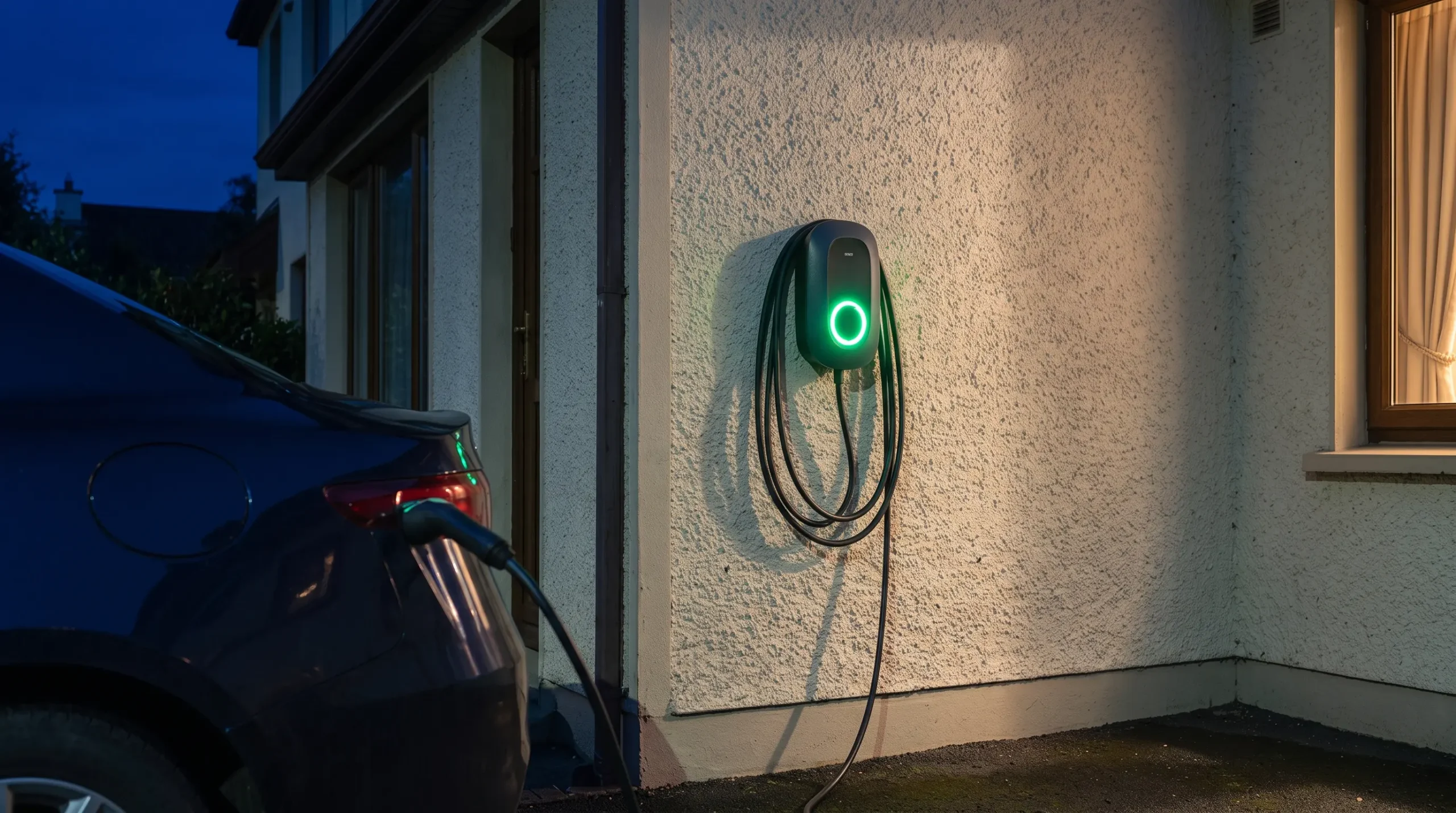
EV charger installation cost in Ireland sits between €1,000 and €1,800 supplied and fitted in 2026 for a standard 7.4kW home unit. After the €300 SEAI home charger grant, most homeowners end up paying somewhere between €700 and €1,500.
That spread is wide for a reason. The charger itself is the predictable part of the bill. What moves the total is your house, specifically the distance from the fuse board to where you park, the age of that board, and the condition of the cabling running out to your ESB meter box.
How Much Does EV Charger Installation Cost in Ireland in 2026?
A straightforward 7.4kW home charger costs €1,000 to €1,800 supplied and fitted before the grant is applied. The unit accounts for roughly half of that, with cable, protective devices, labour, testing and certification making up the balance. Everything below is a typical market range rather than a quote.
| Charger and installation | Typical installed price | After the €300 grant |
| 7.4kW untethered smart charger, standard install | €1,000 to €1,300 | €700 to €1,000 |
| 7.4kW tethered smart charger, standard install | €1,150 to €1,500 | €850 to €1,200 |
| 7.4kW solar aware smart charger, standard install | €1,400 to €1,900 | €1,100 to €1,600 |
| 22kW three phase charger, three phase supply already present | €1,800 to €2,500 | €1,500 to €2,200 |
A standard quote assumes a cable run of roughly ten metres or less, and covers the following.
- A smart charger listed on SEAI’s Smart Charger Register, which is a grant condition
- A dedicated radial circuit with its own protective device in the fuse board
- Cable, containment and exterior wall mounting rated for outdoor use
- Testing, commissioning and setup of the charger app
- Certificate Number 3 and a Test Record Sheet from a Safe Electric registered electrician, which SEAI checks before paying out
Tethered units have the cable permanently attached, which costs more up front but saves you lifting a cable out of the boot every night. A price quoted over the phone without a site visit or a photo of your fuse board is a starting figure only.
Which Site Conditions Push EV Charger Installation Costs Higher?
Four things account for nearly every price gap between two quotes on the same charger. Cable run length, the state of the fuse board, the size of the tails feeding that board, and whether cable has to cross a driveway. All four are judged on a survey rather than a phone call.
| Additional work | Typical extra cost |
| Cable run beyond about ten metres | €100 to €300 |
| Fuse board replacement or upgrade | €400 to €900 |
| Trenching and ducting under a driveway | €200 to €500 |
| Meter tails, earthing or bonding upgrade | Priced after survey, outside grant support |
Cable run is the simplest of the four. A board in a hallway press with the car parked at the far gable is a very different job to one sitting in an attached garage.
Meter tails are the item most likely to catch people out, and SEAI flags this in its own guidance. The live and neutral tails running between your fuse board and the outdoor meter box should be at least 16mm squared in cross section, and in homes built before 2000 they are frequently undersized.
The catch is that this remedial work falls outside grant support, so it sits on top of the €300 you get back. Better to know about it at survey stage than on the invoice.
Will a 12kVA Home Supply Handle a 7.4kW EV Charger?
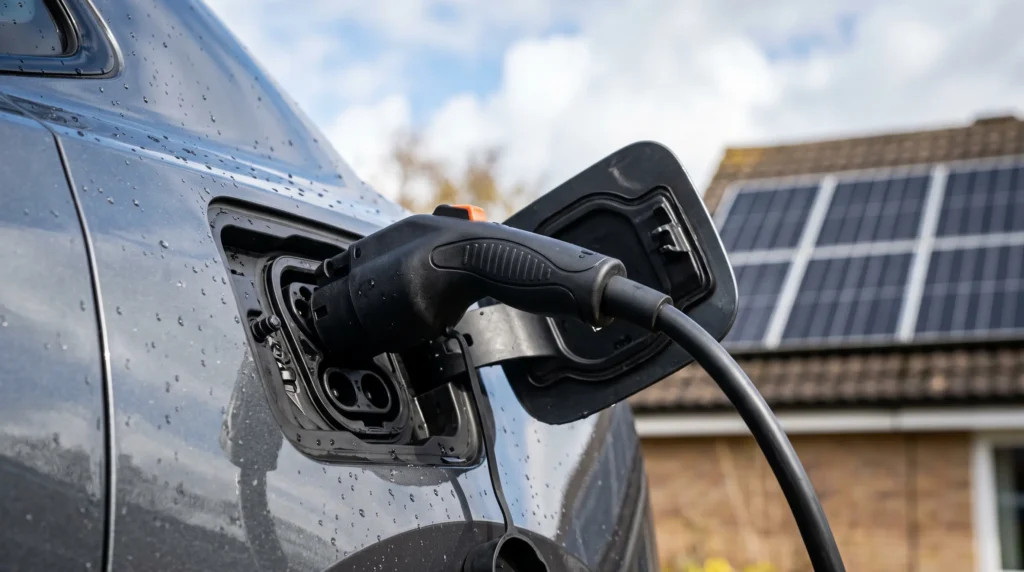
In most cases, yes. The standard domestic connection in Ireland is 12kVA, and ESB Networks confirms that a home charge point up to 7kW needs no connection upgrade as long as the household stays inside that capacity. Trouble starts when the charger runs while everything else in the house is running too.
| Household load | Typical demand |
| Electric power shower | 8kW to 10kW |
| Electric oven | 2.4kW to 5kW |
| Immersion heater | 3kW |
| Kettle | 2kW |
Add a 7.4kW charger to a shower and an oven and you are past the 12kVA ceiling, which trips the main fuse. A demand management device solves this, and it is the fix SEAI recommends. A clamp on the main incoming line throttles the car back, or pauses it, whenever the rest of the house needs the headroom.
How Much Does the SEAI Grant Take Off an EV Charger Installation?
€300 as of September 2026, paid by bank transfer once the work is done and the paperwork clears. It covers 100% of eligible costs up to that ceiling, meaning the charger and the installation itself, but not remedial work such as meter tails, earthing or bonding upgrades.
- No work can start before the date on your Letter of Offer, or the spend becomes ineligible
- You have six months from that offer to finish the job and submit the claim
- Only one charger per MPRN qualifies, and the property must not have claimed before
- The electrician must be Safe Electric registered and issue Certificate Number 3 with a Test Record Sheet
- Payment lands roughly four to six weeks after SEAI receives every document
Grant rates change, so check the current amount on the SEAI grants page before you apply. Plenty of people also ask who fills in the forms, and on grant work we handle the application end to end.
Is a 22kW Three Phase EV Charger Worth the Extra Cost?
For the large majority of Irish homes, no. A 22kW unit only delivers 22kW where the property already has a three phase supply and the car’s on-board charger can accept it, and most family EVs cap AC charging at 7.4kW or 11kW. It suits a narrower group than the marketing suggests.
- Rural properties and farms that already have three phase installed for machinery
- Two EV households charging both cars in the same overnight window
- Homes with very high daily mileage where a 7.4kW overnight charge falls short
Converting a single phase house to three phase purely for charging runs to several thousand euro, quoted case by case by ESB Networks.
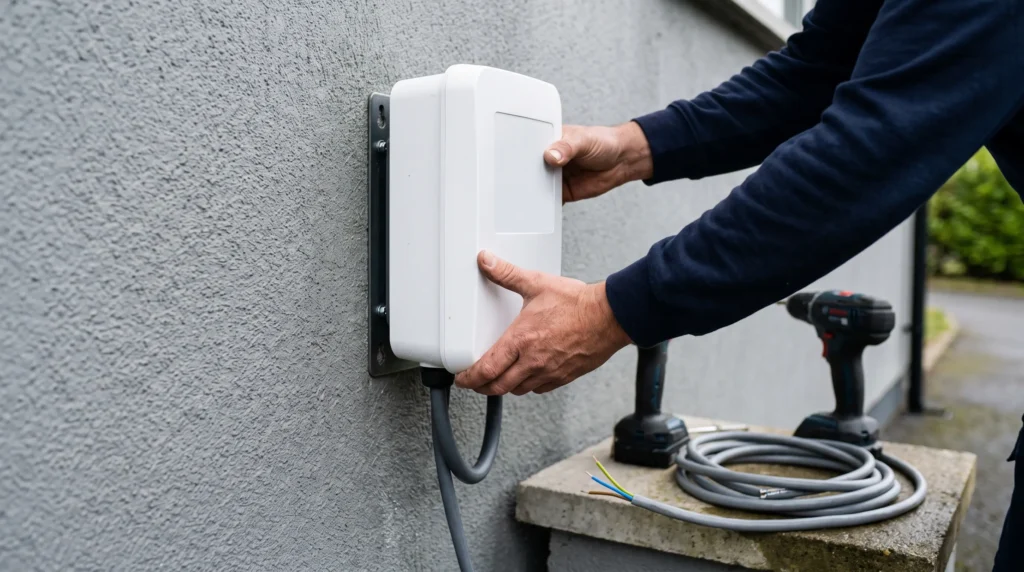
What Does Charging an EV at Home Cost Compared to Public Charging?
Home charging on a night rate runs roughly €1 to €2 per 100km in 2026, against €9 to €13 on public DC fast chargers. At average mileage that gap usually covers the cost of the installation within the first couple of years, though it depends on how much of your charging happens at home.
| Charging method | Typical 2026 rate per kWh | Cost per 100km at 18kWh |
| Home EV night rate tariff | 6c to 12c | €1.10 to €2.20 |
| Standard home day rate | 30c to 35c | €5.40 to €6.30 |
| Public AC charge point | 35c to 60c | €6.30 to €10.80 |
| Public DC fast charger | 50c to 70c | €9.00 to €12.60 |
EV night rate plans usually carry a higher day rate and a different standing charge, so the cheapest overnight window is not automatically the cheapest annual bill.
How Solar Panels Change the Running Cost of an EV Charger
Solar drops the daytime charging cost to whatever that unit would have earned as an export credit, which is a fraction of the day rate. On a typical domestic array of 3.5kWp to 6.4kWp, a 7.4kW charger draws more than the roof makes at almost any moment, so the pairing needs a charger that can modulate.
A solar aware charger reads the surplus at the meter and matches the car’s draw to it. Most give you three modes.
Surplus only, where the car charges purely on what would otherwise be exported
- Blended, where solar covers what it can and the grid tops the rest up to a set rate
- Fast, where the charger ignores solar entirely and pulls full power
Whether the premium is worth paying comes down to when the car is at home. A commuter car that leaves at eight and returns at six charges on the night rate regardless. You can estimate your own costs with our solar calculator before deciding either way.
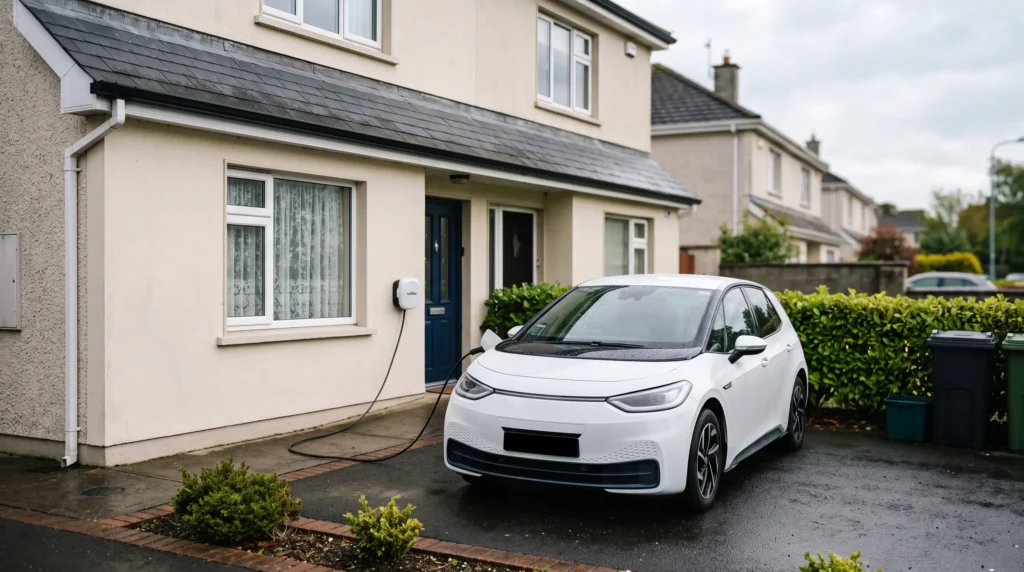
Getting an Accurate Price for Your Home Charger Installation
Budget €1,000 to €1,800 for a standard 7.4kW installation in 2026, take €300 off with the grant, and hold a few hundred in reserve for board or tails work if the house predates 2000. Compare the scope of each quote before you compare the headline number, because the cheapest price is usually the one that assumed the least.
- Ask what cable run length the price assumes and what each additional metre costs
- Confirm the fuse board has been assessed, from a photo if there was no site visit
- Check whether demand management is included or priced as an add-on
- Ask whether meter tails, earthing and bonding were inspected, since that work sits outside the grant
- Confirm the charger is on SEAI’s register, because an ineligible unit costs you the €300
Have the EV charger grant sorted first, since the offer letter has to be in hand before any work starts.
If you are weighing a charger alongside panels, talk to our team about a home solar assessment and we will size the system around how and when you actually charge.