
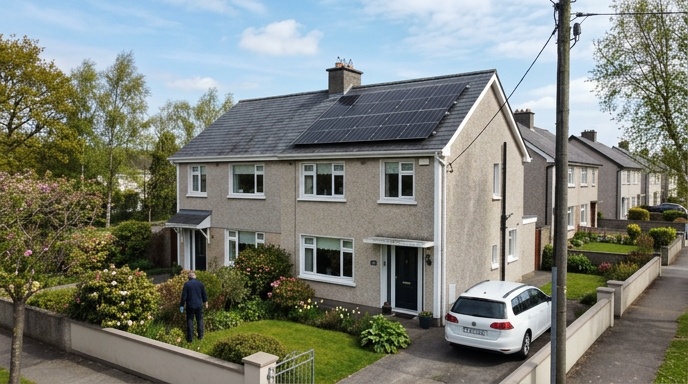
If you’re weighing up solar panels for your home in 2026, the honest answer is yes, they’re worth it for most Irish homeowners, but the payback depends heavily on your electricity usage, roof, and how you use the system day to day. A typical 4kWp system costs around €8,000 to €10,000 before the €1,800 SEAI grant, and most households see payback within 6 to 8 years.
That said, the numbers aren’t the same for everyone. A retired couple at home during the day will hit break-even far faster than a family who’s out from 8 til 6. The direction your roof faces, whether you add a battery, and your current electricity rate all shift the maths.
In this guide we’ll walk through the real costs, the grants you can still claim, and what payback looks like based on actual installs across Ireland in 2026.
How Much Do Solar Panels Actually Cost in 2026?
Pricing has settled in the last year after a few volatile ones. For a standard Irish semi-detached home, you’re looking at a fairly predictable range depending on system size.
- 2.5kWp system (6 panels): around €6,500 to €7,500 installed
- 4kWp system (10 panels): around €8,500 to €10,000 installed
- 6kWp system (14-16 panels): around €11,000 to €13,500 installed
- Battery storage add-on: €3,000 to €5,000 depending on capacity
- Hot water diverter (Eddi or similar): around €700 to €900
All prices are inclusive of 0% VAT, which the government kept in place to keep solar accessible. You then knock the SEAI grant off the top, so a €9,500 system effectively becomes €7,700 out of pocket. For the estimated budget, you can use a reliable solar calculator by SPV Energy.
What Grants Can You Still Claim in 2026?
Grant funding is the single biggest reason people install now rather than wait. The schemes are still generous, but eligibility rules matter.
SEAI Solar Electricity Grant
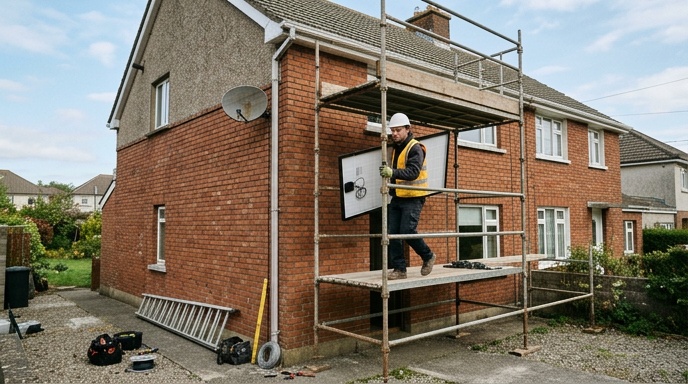
The SEAI Solar Electricity Grant offers up to €1,800 for homeowners. The property must have been built and occupied before 2021, and the installer must be SEAI-registered.
Payment lands in your bank once the paperwork is submitted after installation, and in our experience it comes through inside three weeks.
You can check the current terms directly on the SEAI Solar Electricity Grant page, which is updated whenever the scheme changes.
Microgeneration Feed-in Tariff
Any surplus electricity you export back to the grid earns you credit from your supplier. Rates vary between €0.18 and €0.24 per kWh depending on who you’re with. You’ll need a smart meter installed, which ESB Networks will fit free of charge if you don’t already have one.
Non-Domestic and Farm Grants
Businesses can claim up to €162,600 through the Non-Domestic Microgen Grant, while farmers can go through the TAMS 3 scheme. Commercial installs also benefit from the Accelerated Capital Allowance, which lets you write off 100% of the cost in year one against tax.
Realistic Payback Timelines Based on 2026 Installs
Here’s where the honesty comes in. Some installers throw around 4-year payback figures that only work if you’re using electricity all day, exporting heavily, and paying premium unit rates. Real-world numbers are a bit more grounded.
For a household paying around €0.35 per kWh on electricity, using roughly 4,500kWh per year, here’s what payback looks like on a 4kWp system costing €8,700 after the grant.
- Annual generation: around 3,600 to 4,000kWh in a decent Irish year
- Self-consumption without battery: typically 30 to 40% of what you generate
- Self-consumption with a 5kWh battery: 70 to 85%
- Typical annual savings without battery: €900 to €1,100
- Typical annual savings with battery: €1,300 to €1,600
- Payback without battery: 7 to 9 years
- Payback with battery: 6 to 8 years
Panels are warrantied for 25 years and typically last longer. So after payback, you’ve got 15+ years of essentially free electricity, which is where the real value sits.
Who Gets the Best Return From Solar in Ireland?
Not every home is a perfect fit, and any installer worth their salt will tell you that upfront. Here are the households where solar makes the strongest financial case.
Homes With Daytime Usage
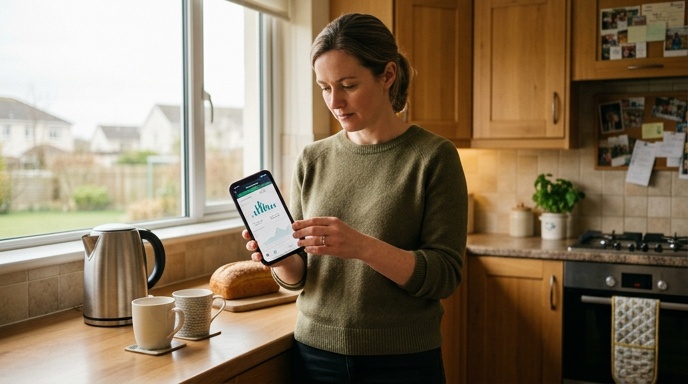
If someone’s home during the day, whether that’s retirees, remote workers, or families with young kids, self-consumption goes way up. Every unit you use directly from the panels is worth the full retail rate you’d otherwise pay to your supplier.
South, East, or West-Facing Roofs
South-facing is ideal, but east or west still produce well. You just get a flatter generation curve rather than a big midday peak. North-facing alone rarely stacks up, though a split east-west array often does.
Homes With Electric Heating or an EV
If you drive an EV or heat water with an immersion, your electricity bill is likely well over €3,000 a year.
Solar with a diverter can slash the immersion cost to zero in summer, and pairing solar with an EV charger means cheap or free miles from April through September.
When Solar Panels are Not Worth It in Ireland
To be genuinely honest, there are situations where we’ve told homeowners to hold off or spend the money elsewhere.
- Roof needs replacing within 5 years. Do the roof first, then the panels.
- Heavy shading from trees or nearby buildings that can’t be removed.
- Very low electricity usage under 2,500kWh a year. The payback stretches out too long.
- Property built after 2021, which rules out the Solar panel grant and adds €1,800 to the effective cost.
- Plans to move house within 3 years. You’ll get some value back through a better BER rating, but not the full financial return.
In those cases, a heat pump, better insulation, or an EV charger often gives better bang for buck. It’s worth reading through our breakdown of solar panel grants in Ireland before you commit, just so you know exactly what you can and can’t claim.
Should You Add a Battery with Solar Panels in 2026?
Battery prices have come down noticeably, and for most households they now make financial sense, not just environmental sense.
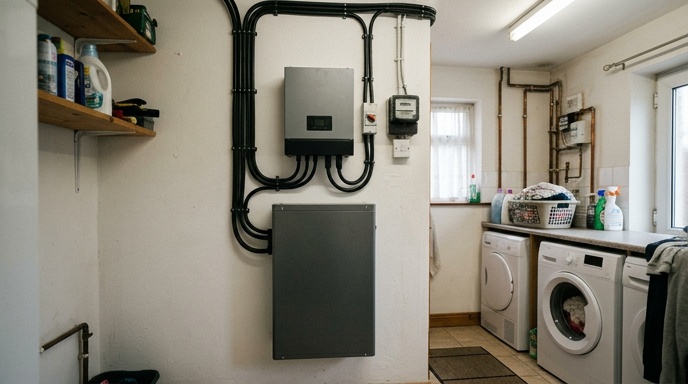
A 5kWh battery shifts your self-consumption from around 35% to over 75%, meaning far more of what you generate offsets units you’d otherwise buy at €0.35.
The catch is upfront cost. Adding €3,500 to a €9,500 install pushes the total to €13,000. After the grant, you’re around €11,200.
Payback stretches to 7 or 8 years, but you’re also insulated against future electricity price hikes, which is a real consideration given how prices have moved since 2022.
Batteries also open up cheap night-rate charging. On a smart tariff, you can fill the battery at €0.10 per kWh overnight and use it during peak hours, which adds another layer of savings on cloudy days.
The Verdict for 2026
For the vast majority of Irish homeowners with a suitable roof and reasonable electricity usage, solar panels are absolutely worth it in 2026.
Payback sits between 6 and 9 years, the equipment lasts 25+ years, and the grant plus 0% VAT mean the entry cost is the lowest it’s been.
The people who don’t see the value usually fall into one of the exception categories above, or they’ve been oversold a system that’s too big for their actual usage. That’s why a proper site survey matters more than a low headline price.
If you’d like an honest assessment on your own home, get in touch with us for a no-pressure quote and we’ll run the real numbers for your roof, usage, and budget.