
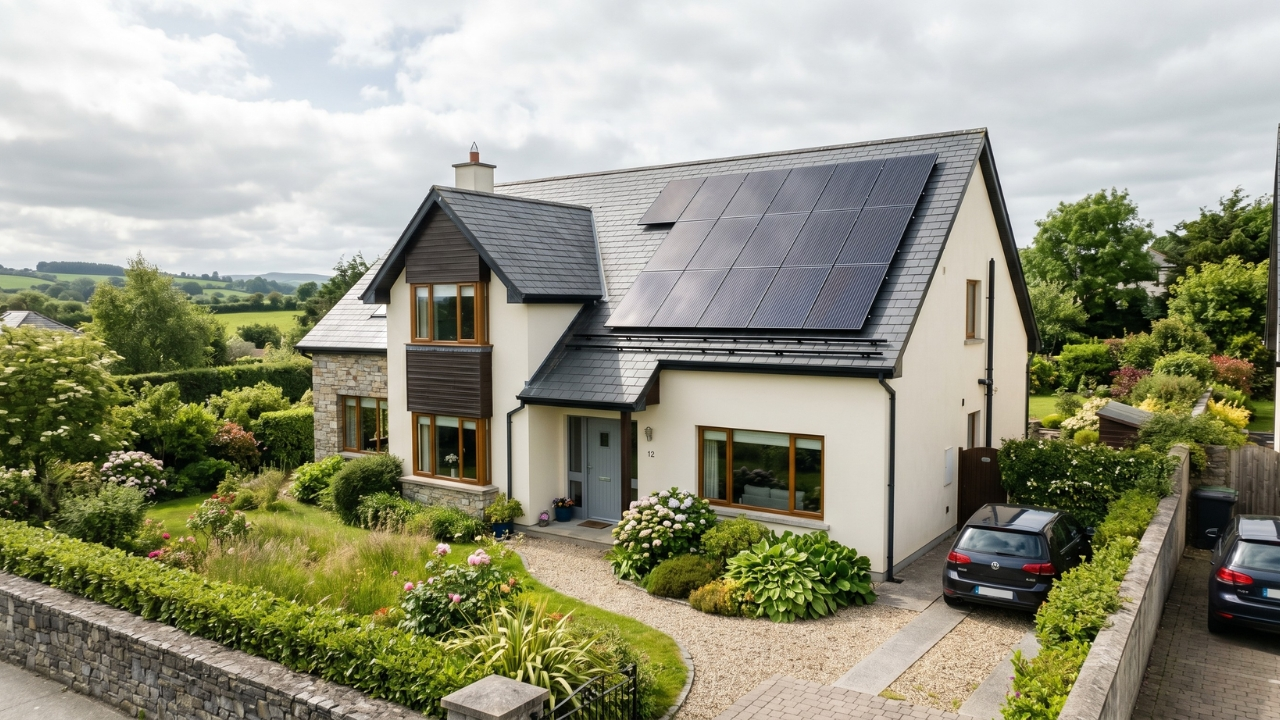
The SEAI solar panel grant in Ireland is worth up to €1,800 towards the panels, plus a flat €600 towards a home battery of 5 kWh or larger. That is a maximum of €1,800 on a standard application, and homeowners on certain social welfare payments can reach €9,000.
Two things changed on 6 October 2026, and most of the advice still floating around online predates both. Battery storage now has a grant of its own for the first time in years. The eligibility cut-off also moved, so homes built and occupied before 2025 now qualify rather than only pre-2021 properties.
One rule has not changed, and it is still the one that catches people out. You have to hold a written grant offer before any work starts on the roof. Here is what the grant pays, who qualifies under the new rules, and how the application runs from quote to payment.
How Much Is the Solar Panel Grant in Ireland in 2027?
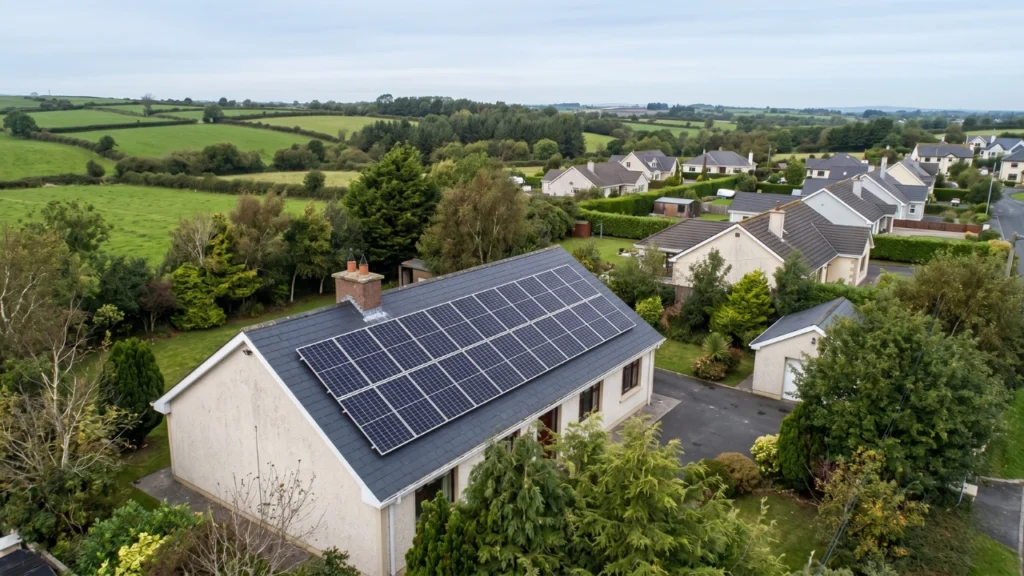
The grant is paid pro rata on system size, at €700 per kWp for the first 2 kWp and €200 per kWp for each additional kWp up to 4 kWp. Anything above 4 kWp attracts no further grant. Add the battery grant and a standard household can claim up to €1,800 in total.
| System size | Solar PV grant | Battery grant (5 kWh or larger) | Combined |
|---|---|---|---|
| 2 kWp | €1,400 | €600 | €3,000 |
| 2.5 kWp | €1,500 | €600 | €1,800 |
| 3 kWp | €1,600 | €600 | €2,200 |
| 4 kWp or more | €1,800 | €600 | €1,800 |
You can still install a larger array than 4 kWp, and most three and four-bed homes do. The grant simply stops climbing at the cap. The figures above come straight from the SEAI solar electricity grant scheme, which is funded under the government’s Microgeneration Support Scheme.
Solar PV supply and installation is also zero-rated for VAT, so the grant is not the only thing taking money off the invoice. If you want to see how a given array size maps to your own electricity use before you commit, the solar calculator gives you a starting estimate in a couple of minutes.
Who Qualifies for the SEAI Solar Panel Grant?
Eligibility is property-based rather than income-based, so there is no means test on the standard grant. The headline change is the build date. Your home now needs to have been built and occupied before 2025, widened from the old pre-2021 rule, which brings a large number of newer houses into the scheme for the first time.
The full checks are short enough to run yourself:
- The property was built and occupied before 2025.
- It has a valid Meter Point Reference Number (MPRN), printed at the top of your electricity bill.
- No SEAI funding has been drawn for that same measure at that MPRN before.
- The work is carried out by an SEAI-registered solar PV company.
- Grant approval is in place before installation begins.
How the €600 Battery Grant Works Alongside Solar PV
The Battery Energy Storage System grant is a flat €600 for any battery of 5 kWh or larger, and a smaller battery gets nothing. Fitting a bigger battery does not increase the payment either. It runs as its own scheme, with the same pre-2025 property rule and the same one-grant-per-MPRN limit as the panels.
You have three routes to it:
- Apply for the panels and the battery together through a single application.
- Add a battery grant application to an existing solar PV application already in the system.
- Apply for a battery on its own, with no solar panels at all.
There is a VAT catch worth knowing before you decide. A battery installed with panels under one contract carries 0% VAT, while a standalone battery retrofit attracts the standard 23% rate on the full cost. SEAI’s own guidance on the home battery grant puts a fully installed battery in the region of €3,500 to €5,500, so that VAT difference is real money.
Enhanced Solar Grants Worth Up to €9,000 for Qualifying Households
Homeowners receiving a qualifying Department of Social Protection payment can claim an enhanced rate of up to €8,400 for the panels plus €600 for the battery, capped at €9,000 combined. The enhanced rates are €3,350 per kWp for the first 2 kWp and €850 per kWp up to 4 kWp.
| System size | Enhanced solar PV grant | With a 5 kWh battery |
|---|---|---|
| 2 kWp | €6,700 | €7,300 |
| 3 kWp | €7,550 | €8,150 |
| 4 kWp | €8,400 | €9,000 |
Households that meet the Warmer Homes criteria sit outside this entirely. There, solar PV and battery storage are delivered as fully funded measures, with SEAI surveying the property and deciding the upgrade package.
How to Apply for the Solar Panel Grant Step by Step
The sequence matters more than the paperwork. Grant approval has to land before the first panel goes up, and SEAI will not backdate an application against work already started.
- Get quotes from SEAI-registered companies. Shop around and get a written contract covering the works, price, timing and warranties.
- Apply online and wait for the Letter of Offer. Check that the company named in the offer is the one actually doing the job.
- Let the installer lodge the ESB Networks NC6 form. The grid connection application usually takes at least 20 working days, so it runs in parallel with scheduling.
- Complete the installation inside eight months. After eight months the grant offer expires and will not be paid.
- Book the post-works BER assessment. A registered BER assessor has to publish it before the grant can be drawn down.
- Submit the Declaration of Works and supporting documents. SEAI advises allowing four to six weeks to process payment into your nominated account.
Most of steps 2 to 6 are handled for you when a full-service installer runs the application, which is how home solar installations are usually managed in practice.
5 Mistakes That Cost Homeowners the Solar Grant
Nearly every lost grant comes down to a handful of avoidable errors, and starting work early is the big one. These are the traps worth checking against your own plan:
- Beginning the installation before the Letter of Offer arrives.
- Using a company that is not on the SEAI register for the relevant scheme.
- Letting the eight-month completion window lapse.
- Skipping or delaying the post-works BER, which blocks payment.
- Changing the system size or the installer without telling SEAI first.
That last one has a sting attached. Changing company means cancelling and recreating the application, and you are then entitled to the grant amounts in effect on the date of the new application, not the original one. If rates move in between, you get the new rate.
Grants for Businesses, Farms and Schools in Ireland
Non-domestic applicants use a separate scheme, the Non-Domestic Microgen Grant, which has been temporarily lifted to an effective 45% of eligible costs for new applications made between 6 October 2026 and 6 July 2027. The maximum is €325,200, covering systems up to 1,000 kWp.
Businesses, farms, schools, community centres, public sector bodies and non-profits can all apply. Batteries are not eligible costs under this scheme, and the payment is the lower of the value on the application summary or 45% of the invoiced cost. Farmers have a second route through TAMS 3 with the Department of Agriculture, and the two cannot be stacked on the same installation.
A full breakdown of the commercial, agricultural and schools routes sits in our guide to solar grants in Ireland, including the tax treatment that applies to business installations.
Get Your Grant Approved Before the Install Is Booked
The money on the table is better than it has been in years, and the application itself is the easy part. Picking an installer who is not on the SEAI register, or letting someone start work before the offer email arrives, is what actually costs people the grant.
Talk to a registered installer about what your property qualifies for. Request a free quote and we will confirm your eligibility and handle the SEAI paperwork from application through to payment.