
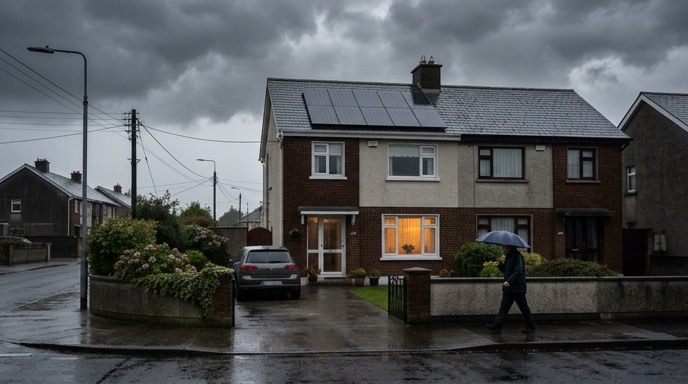
Power cuts in Ireland tend to arrive at the worst possible moment. A storm rolls in off the Atlantic, the lights flicker, and suddenly you’re hunting for candles while the fridge ticks away in silence. If you’ve already invested in solar panels, it’s a fair question to ask whether all that gear on your roof can keep things running when ESB Networks goes down.
Here’s the short answer. A standard grid-tied solar PV system will not work during a power outage, even in bright sunshine. To keep your home powered when the grid fails, you need a battery with backup capability or a hybrid inverter with an EPS (Emergency Power Supply) function. Without that extra kit, your panels shut off automatically the moment the grid drops.
It catches a lot of homeowners off guard. Below, we’ll walk through why that happens, what kind of system you actually need for blackout protection, and what it costs to set up properly here in Ireland.
Why Standard Solar Panels Switch Off During a Blackout
It seems counterintuitive. The sun is shining, your panels are generating, and yet the kettle won’t boil. The reason comes down to safety, not a fault with your system.
Grid-tied solar inverters are required by law to shut down the moment they detect a loss of grid power. This is called anti-islanding protection, and it’s mandated by ESB Networks for every solar PV system connected to the Irish grid.
- If your panels kept exporting electricity during a blackout, that current would flow back into the local network.
- Engineers working to restore power could be seriously injured by live wires they expected to be dead.
- Equipment further down the line could also be damaged by uncontrolled voltage.
So when the grid drops, your inverter senses it within milliseconds and disconnects. The panels are still producing DC electricity on the roof, but there’s nowhere for it to go. Until the grid comes back online, the system stays dormant.
What You Actually Need For Backup Power
If you want your home to stay powered during outages, you need to step beyond a basic grid-tied setup. There are two main ways to do this, and the right one depends on how much you want to spend and how much of the house you need running.
Hybrid Inverter With EPS
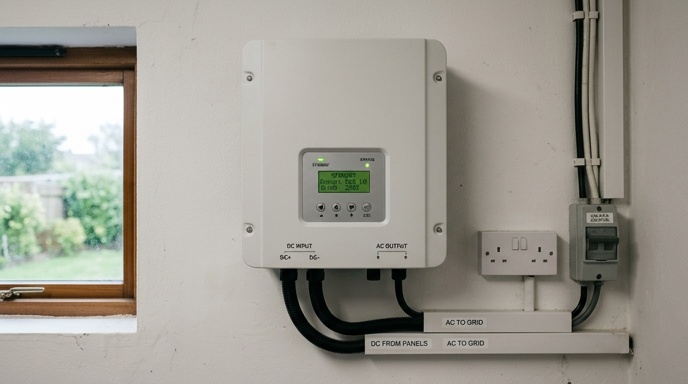
A hybrid inverter combines solar generation and battery management in one unit. Many modern hybrid inverters include an EPS socket or output that activates during a blackout. It provides limited power, usually enough for essentials like lighting, broadband, and a fridge.
The EPS function only works when the sun is shining or the battery has charge. It’s a useful safety net, but it’s not a full whole-home solution.
Battery Storage With Full Backup
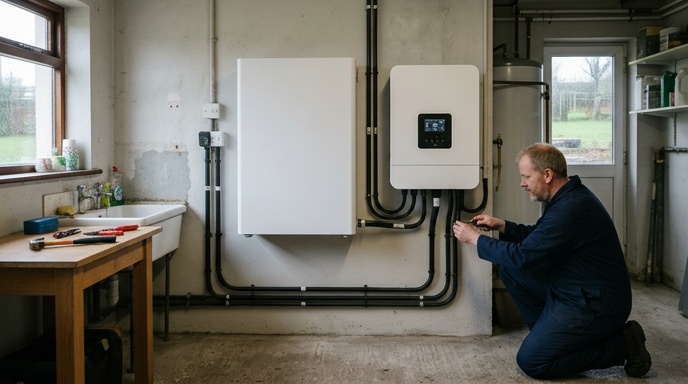
For genuine resilience, you need a battery system designed with backup circuits wired in. This setup isolates your home from the grid during an outage and runs your house from stored energy and live solar production.
- The battery powers selected circuits, typically lights, sockets, the boiler, and the broadband router.
- High-draw items like electric showers, ovens, and immersion heaters are usually left off the backup circuit.
- When the sun returns, the panels recharge the battery automatically.
- Switchover happens within seconds, so most appliances barely notice the gap.
If you’re considering this upgrade, our team can talk you through the residential solar PV options and what battery sizing makes sense for your usage. Most homes in Ireland find a 5kWh to 10kWh battery covers the essentials comfortably.
How Much Does Backup Solar Cost in Ireland?
Pricing varies depending on the size of your solar array, the battery capacity, and whether you’re starting from scratch or retrofitting. As a rough guide for a typical Irish home:
- A 4kWp to 6kWp solar PV system with hybrid inverter and basic EPS function usually lands between €9,000 and €13,000 before grants.
- Adding a 5kWh to 10kWh battery with full backup wiring adds roughly €4,000 to €7,000.
- The SEAI residential grant of up to €1,800 applies to qualifying installations, knocking the upfront cost down.
- 0% VAT on solar panels also helps reduce the total spend.
You can check current grant rates directly with the SEAI solar electricity grant scheme, which covers eligible systems on homes built before 2021. The team here handles all the paperwork for you, so it’s not something you need to chase yourself.
Retrofitting a battery to an existing solar setup is also possible, though the cost depends on whether your current inverter is compatible. In some cases, a separate AC-coupled battery unit is the better route.
What Will Backup Power Actually Run in Your Home?
This is where expectations need to match reality. A typical home battery backup is not designed to run your entire house at full tilt. It’s designed to keep the essentials going so life carries on while the grid is down.
Appliances That Work Fine
- LED lighting throughout the house.
- Fridge and freezer.
- Broadband router and Wi-Fi.
- Phone and laptop chargers.
- Television and small electronics.
- Gas boiler controls and pumps (if you have gas heating).
Appliances to Avoid During an Outage
- Electric showers, which can pull 9kW or more.
- Electric ovens and hobs.
- Immersion heaters.
- Tumble dryers and washing machines on hot cycles.
- EV chargers running at full speed.
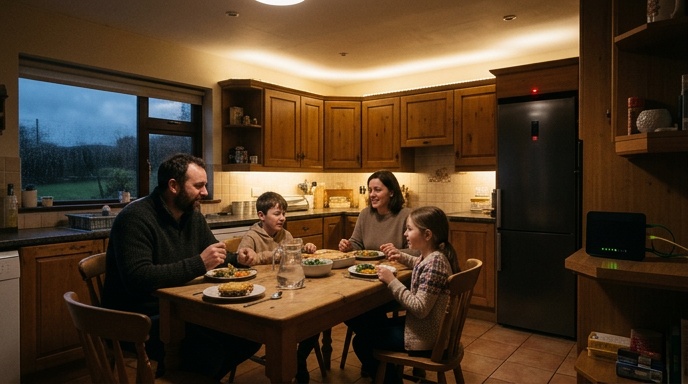
In practice, this means a well-designed system can keep a family comfortable through a multi-hour storm outage without anyone really noticing. The fridge stays cold, the broadband stays up, and the kids can keep watching whatever they’re watching.
Is Backup Worth It in Ireland?
Honestly, it depends on where you live and how much disruption power cuts cause you. Storm Éowyn and a few rough winters have reminded everyone that the grid isn’t always reliable, particularly in rural areas where overhead lines are exposed.
For homes in Cavan, Leitrim, Donegal, Monaghan, and other counties where outages can last days rather than hours, battery backup pays for itself in peace of mind alone. For urban homes in Dublin or Kildare where cuts are usually short, it’s more of a comfort upgrade than a necessity.
That said, even short outages can damage food, knock out medical equipment, or leave you without heating on the coldest nights. If you work from home, the cost of lost productivity during a full day’s outage adds up quickly too. For commercial properties, the case is even stronger, and our commercial solar PV installations can be designed with critical-load backup built in from day one.
Getting the Right Setup From the Start
If you’re planning a new solar installation and outage protection matters to you, mention it during the initial site survey. A hybrid inverter and battery-ready wiring cost very little extra when fitted from the outset, but they’re far more expensive to retrofit later.
For homeowners already with solar, an upgrade is still very doable. The right battery solution depends on your existing inverter, your typical electricity usage, and which circuits you want protected. A proper site visit answers all of that quickly.
Want to talk through whether backup solar makes sense for your home? Get in touch for a no-pressure chat and a free quote, and we’ll map out what’s possible based on your property and budget.