
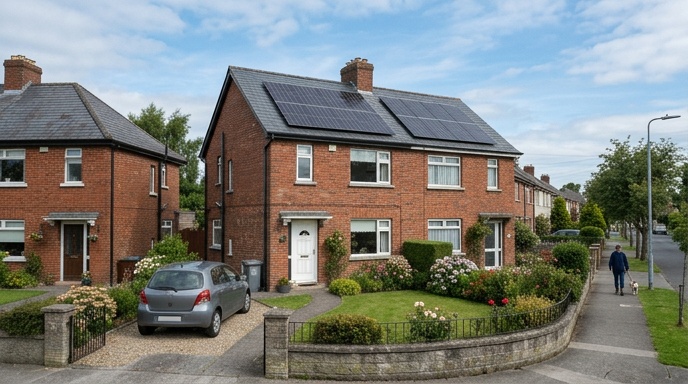
If you’re thinking about going solar, the first question is almost always the same. How many panels do I actually need on the roof? The honest answer depends on your home, your electricity usage, and how much roof space you’ve got to play with.
For most Irish homes, the sweet spot sits somewhere between 8 and 16 panels, giving you a system size of roughly 3.5kWp to 6.4kWp. A three-bed semi with average usage usually lands around 10 to 12 panels, while a larger four or five-bed detached home often needs 14 to 18. Your annual electricity bill is the single biggest clue to what you’ll need.
Below we’ve broken down the sizing question by home type, by annual usage in kWh, and by the practical bits like roof orientation and shading. By the end, you’ll have a much clearer idea of what fits your house.
How to Decide the Number of Solar Panels You Need?
Sizing a solar PV system isn’t just a matter of counting bedrooms. It comes down to how much electricity you actually use across the year, how much of that you can shift to daytime, and what your roof can physically hold.
- Annual electricity usage in kWh: check the last 12 months of bills for the true figure.
- Roof orientation: south-facing is best, but east and west still perform well.
- Roof pitch and available space: each panel needs roughly 1.9 square metres.
- Shading from trees, chimneys or nearby buildings: even partial shade cuts output.
- Whether you’re adding a battery: batteries let you use more of what you generate.
- Future plans: an EV, heat pump or extension will push usage up.
An expert solar panel installer will run through all of this on a site survey before recommending a size. Guessing based on bedrooms alone tends to leave people either short or oversized.
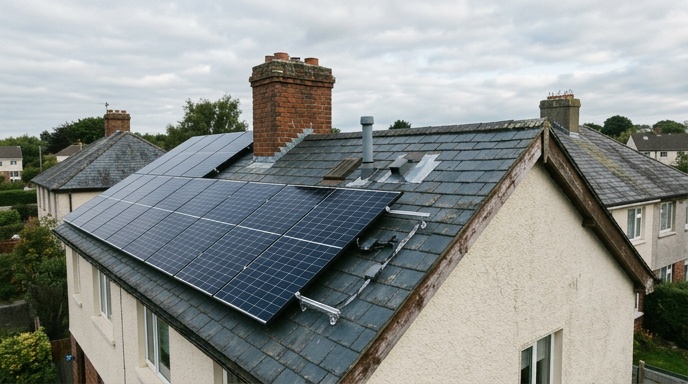
Solar Panel Sizing by Home Type
Here’s a practical starting point for typical Irish homes. These numbers assume average usage patterns and reasonable roof space. Your actual figure could shift up or down once your usage is properly reviewed.
Two or Three-Bed Terraced or Semi-Detached
Usually a smaller household with annual usage around 3,500 to 4,500 kWh. A system of 8 to 10 panels (around 3.5kWp) tends to fit the bill and the roof space nicely. This is one of the most popular sizes we install.
Three or Four-Bed Semi-Detached
Family home with two or three occupants working from home some of the time. Annual usage often sits around 4,500 to 6,000 kWh. You’ll typically want 10 to 14 panels (around 4.2kWp to 5.5kWp).
Four or Five-Bed Detached
Larger homes with higher baseline usage, often 6,000 to 9,000 kWh a year. 14 to 18 panels (5.5kWp to 7kWp) is the usual recommendation, especially if there’s an EV or immersion in regular use.
Six-Bed or Rural Homes with Heat Pumps and EVs
These properties can easily push past 10,000 kWh a year. A system of 18 panels or more paired with a battery is often the right call to keep bills down properly.
How to Size Solar Panels Based on Your Electricity Usage
The most accurate way to size a system is to work backwards from your annual usage. Grab your bills and add up the kWh figures for the last 12 months. That single number is more useful than any bedroom count.
As a rough rule of thumb, a well-oriented 1kWp of solar in Ireland produces around 850 to 950 kWh a year. So a 4kWp system will typically generate somewhere between 3,400 and 3,800 kWh annually.
- Under 4,000 kWh a year — 8 panels, roughly 3.5kWp.
- 4,000 to 5,500 kWh — 10 to 12 panels, roughly 4.2kWp to 4.8kWp.
- 5,500 to 7,000 kWh — 12 to 14 panels, roughly 5kWp to 5.6kWp.
- 7,000 to 9,000 kWh — 14 to 16 panels, roughly 5.6kWp to 6.4kWp.
- Over 9,000 kWh — 16 to 20 panels plus a battery.
Keep in mind that you won’t use every unit as it’s generated. Without a battery, homes typically self-consume 30 to 40 percent of their solar output. The rest gets exported to the grid, and you’ll earn credits under the Microgeneration Support Scheme for that surplus.

Does Roof Space and Orientation Change the Answer?
Yes, and sometimes significantly. You can want 14 panels all you like, but if the roof only fits 10 you’ll need to work with what’s there. Panels are typically around 1.75 metres by 1.1 metres, so each one takes just under 2 square metres of usable roof.
Orientation matters too. In Ireland, south-facing roofs give the strongest yield, but east-west split systems have become very common and perform surprisingly well. They spread generation across the day, which actually suits homes where people are out at lunchtime.
- South-facing — best yield, typically 100 percent of expected output.
- South-east or south-west — around 95 percent, very little difference in practice.
- East or west — around 80 to 85 percent, still very worthwhile.
- North-facing — generally not recommended for panels.
Chimneys, dormers, velux windows and vent pipes all eat into usable roof area. On a site survey, we measure the true clear space and design around obstructions rather than promising a number that won’t physically fit.
Should You Add a Battery to Your System?
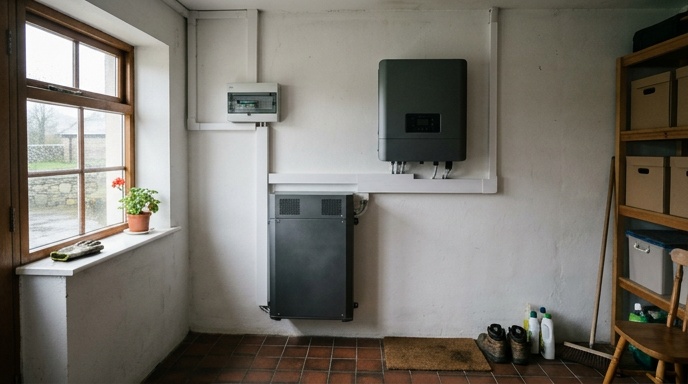
Yes, you can combine a battery with your solar system. But it changes how much of your generation you actually use. Without one, most of your solar production happens during the day when nobody’s home. A battery stores that surplus and releases it in the evening when demand ramps up.
Battery sizing generally scales with system size. A 4kWp to 5kWp system pairs well with a 5kWh battery. Larger systems around 6kWp to 7kWp often benefit from 10kWh of storage, especially if you’re on a smart tariff with cheaper night rates.
Batteries do add to the upfront cost, so weigh them against your usage patterns. If you’re out all day and use most electricity in the evening, a battery pays back much faster. Retired households or people working from home get less benefit because they’re using power as it’s generated.
What About Grants and Payback in Ireland?
Sizing also affects your grant. The SEAI Solar Electricity Grant pays up to €1,800 for domestic installations on homes built before 2021. The grant amount tapers based on system size, so it’s worth checking the current bands on the SEAI grant page before committing.
Payback for most Irish homes lands somewhere between 5 and 8 years depending on your usage, tariff and whether you added a battery. After that, the system continues to generate for another 15 to 20 years of pure savings.
On the commercial side, businesses can access the Non-Domestic Microgen Grant of up to €162,600, plus a 100 percent write-off in year one under the Accelerated Capital Allowance. That combination makes commercial solar particularly strong right now.
Getting the Right Recommendation for Your Home
The best way to answer the panel question properly is a proper site visit by experts. A good survey by our team will look at your usage bills, measure roof space, check for shading, and factor in future plans like an EV or heat pump.
If you’re weighing up your options, get a free quote and a straight recommendation based on your actual usage, not a generic bedroom count. We’ll design the system around your home and handle the SEAI grant paperwork from start to finish.